
Share



How to choose your laser hair removal clinic: the complete guide to making the right choice in 2026
You have decided to start laser hair removal.
Now one question remains, and it probably matters more than any other: where should you go, and how do you choose the best permanent hair removal clinic?
Type “laser hair removal” into Google and within seconds you will find medical centres, beauty salons, nursing practices, franchises, promotional offers, technologies with sometimes highly technical names and promises ranging from “long-lasting smooth skin” to “zero hair guaranteed”.
With all this information, it can be difficult to know what really makes the difference.
Yet not all laser hair removal clinics are equal. And your choice should not be based solely on proximity, Google reviews or the price of a package.
The quality of laser hair removal depends on three inseparable elements: the professional and their expertise, the technology used and the quality of the protocol.
A good device used incorrectly can deliver poor results. Conversely, a serious professional should know how to analyse your skin, hair growth, medication and sun-exposure habits, and adapt the laser settings at every session.
So how can you recognise a trustworthy clinic before your first laser pulse?
Here are the criteria to check, the questions to ask and the warning signs to look out for.
This is the first question to ask.
Since the Decree of 24 May 2024, non-therapeutic laser hair removal in France may be performed by doctors, as well as state-registered nurses and certain qualified beauty professionals, subject to the regulatory conditions in force.
The Order of 19 February 2025 subsequently introduced specific foundation training for the professionals concerned.
For laser alone, this training lasts four days and includes theory, practice and assessment. Refresher training is then required every five years.
In October 2026, a transitional period is still in effect.
The Order of 11 August 2026 postponed the deadline for the professionals concerned to complete this foundation training until 1 September 2027.
It would therefore be too simplistic to assume that a professional practising in 2026 without a final certificate is automatically operating illegally.
However, they should be able to clearly explain:
“What is your qualification and what training have you completed to perform laser hair removal?”
A serious professional should have no difficulty answering this question precisely.
A vague answer such as “don't worry, we're trained” is far less reassuring than a clear explanation.
This is probably the most important criterion in this guide.
Laser hair removal is not a standardised treatment where everyone receives the same settings.
Before treatment, the professional should examine your skin and hair.
The DGCCRF states that the professional must carefully examine the skin before treatment, assess the phototype, check for signs suggesting a contraindication and adapt the device settings to the consumer's phototype.
The professional should also determine whether the area you want treated is genuinely a good indication for laser.
Dark, thick hair does not respond in the same way as very fine downy hair.
The face is not treated exactly like the lower legs.
Light skin and highly pigmented skin do not necessarily require the same parameters.
You arrive for your first appointment and five minutes later you are already under the laser without a questionnaire or genuine examination of your skin.
That is a warning sign.
The assessment is not a commercial formality before selling a package.
It is what allows the protocol to be built correctly.
You do not need to become a laser engineer before your appointment.
But you have every right to ask which device will be used on your skin.
Most importantly, the professional should know how to answer you.
“What technology do you use?”
“What wavelength does your laser use?”
“Why is this technology suitable for my phototype and hair?”
What matters is not whether the professional can recite a technical specification sheet.
What matters is whether they can explain the reasoning behind the choice.
Laser hair removal works through the absorption of light energy by the melanin in the hair. The wavelength and settings must therefore take into account both the hair and the amount of melanin present in the skin.
This is one reason why certain devices or wavelengths may be better suited to certain phototypes.
You can absolutely ask.
A serious clinic has no reason to hide the name of its equipment.
Ask:
“What exact model of laser do you use?”
This will also allow you to check that you are dealing with a genuine laser rather than an IPL device being incorrectly presented as one.
This is something many consumers do not realise.
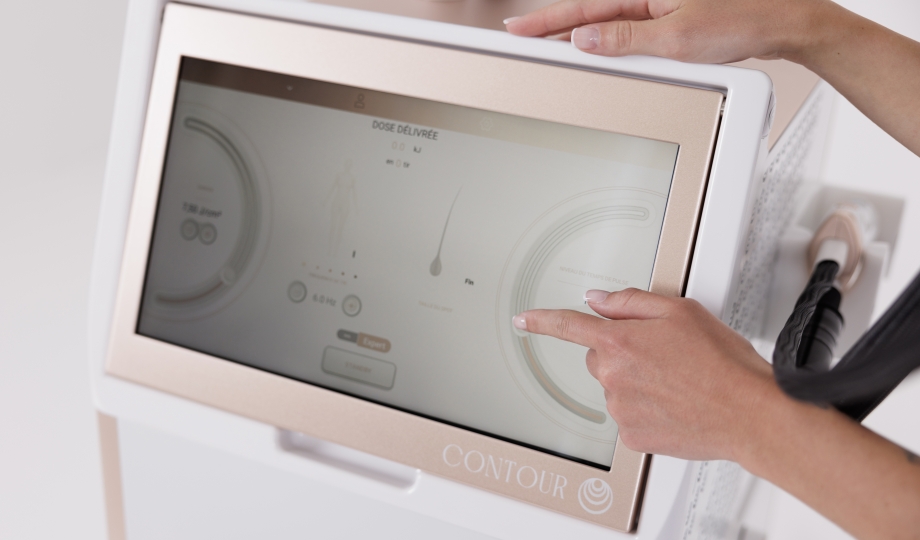
A laser should not simply operate using a “light skin”, “dark skin” or “legs” button.
Several settings may need to be adjusted depending on your skin, hair and reaction to previous sessions.
A serious protocol evolves.
Over the course of treatment:
“Are the settings adapted at every session, or do you always use the same parameters?”
The answer should be obvious: they should be reassessed.
A proper assessment does not stop at the colour of your hair.
Some treatments can affect skin sensitivity or require particular precautions.
The professional should therefore ask which medications you are currently taking.
You should mention them even if they seem unrelated to hair removal.
Never stop medical treatment on your own simply to undergo a laser session.
If there is any doubt, the professional should be able to refer you to your doctor or request medical advice before continuing.
Ask the professional how they manage sun exposure.
Their answer will tell you a great deal about how seriously the clinic approaches treatment.
Tanned skin contains more melanin, which can alter how the skin absorbs laser energy and increase the risk of adverse reactions.
The French Society of Dermatological Lasers reminds patients that tanned skin requires particular precautions and that untanned skin is easier to treat.
A rigorous professional will therefore regularly ask:
“Have you been exposed to the sun recently?”
not only during your first appointment.
The professional chooses to postpone your session because you have recently been exposed to the sun.
This may be frustrating at the time.
But it is precisely what you should expect from a professional who prioritises safety over their appointment schedule.
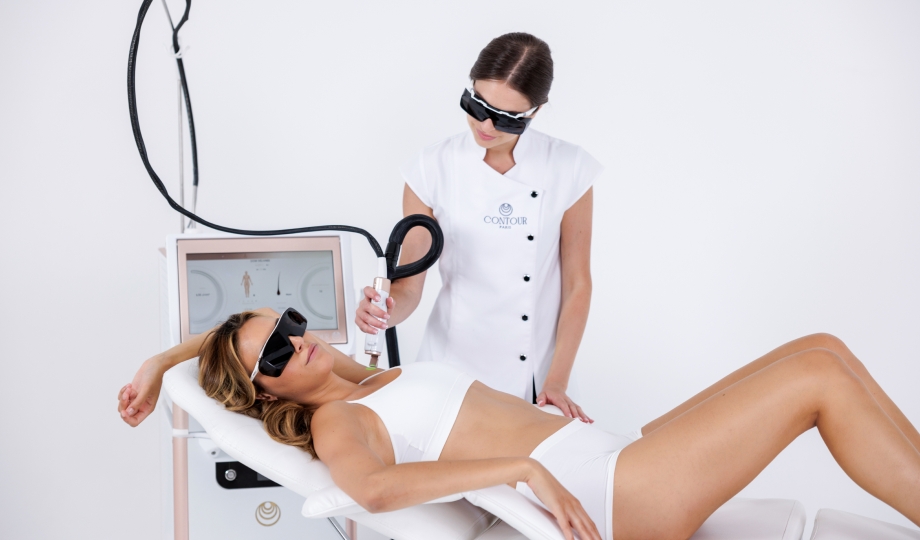
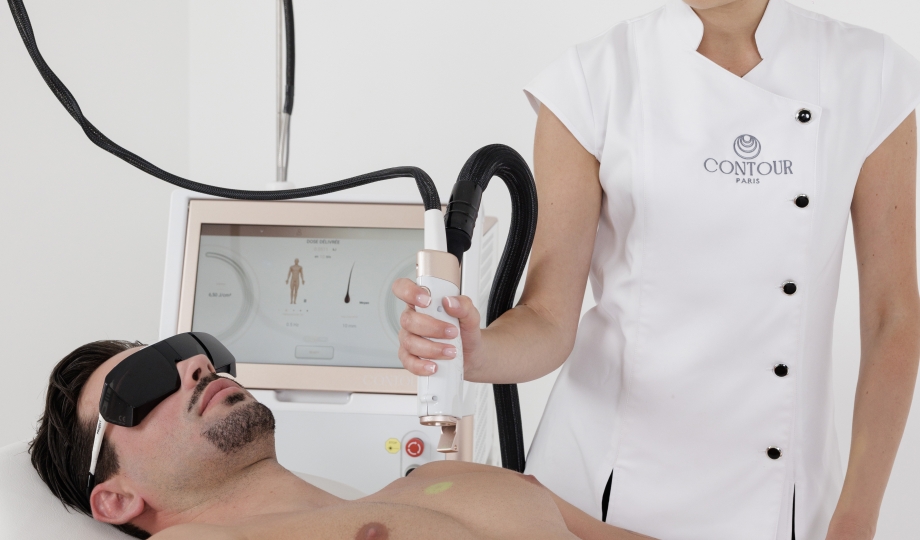
Laser light can present a risk to the eyes.
Appropriate eye protection must therefore be used during treatment.
You should never hear:
“Just close your eyes.”
or:
“It's only a small area, so it's not necessary.”
Both the professional and the client should use protection suited to the equipment.
A good clinic should not promise the impossible.
Be cautious of statements such as:
The number of sessions varies depending on the treatment area, hair cycle, hormonal profile, hair thickness, pigmentation, phototype and individual response.
A competent professional should be able to explain what you can reasonably expect.
They should also tell you when your hair is not a good indication for laser treatment.
For example, white or very lightly pigmented hair responds poorly because melanin is the main target of laser energy.
Packages are not a problem in themselves.
What should raise questions is being sold six, eight or ten sessions before your skin and hair have actually been assessed.
The number of sessions remains an estimate.
Before purchasing a package, ask:
Prices can vary significantly between two clinics in the same city.
But comparing only the price of one session can be misleading.
You should also compare:
Laser and intense pulsed light are not the same thing.
A laser emits light at a defined wavelength, whereas an IPL device emits a broader spectrum of light.
If you ask:
“Is this a laser or intense pulsed light?”
the professional should be able to answer immediately.
If you are told “it's basically the same thing”, be cautious.
This may be one of the best selection criteria of all.
A competent professional does not try to perform a session at any cost.
They may postpone or refuse treatment if:
Knowing when to refuse treatment is often a sign of professionalism, not poor customer service.
Mild redness or swelling around the follicles may occur after laser hair removal and can be perfectly normal.
However, you should know who to contact if you experience an unusual reaction.
Ask:
“If I have a reaction after my session, how can I contact you?”
A serious clinic should explain:
Adverse events may also be reported through the official reporting portal.
Laser is a technology.
But the quality of care can also be seen in much simpler details.
During your first visit, observe:
You can absolutely ask:
“Is your equipment serviced and maintained regularly?”
A laser is professional equipment.
Its performance therefore depends not only on the brand or purchase price, but also on how it is used and maintained.
Reviews can give you information about reception, punctuality, availability, follow-up, treatment experience and the overall evolution of hair growth.
But keep one thing in mind:
a customer review cannot assess the technical safety of a protocol.
Use reviews as an additional indicator, never as your only filter.
Check the professional's qualifications and training, the quality of the initial assessment, your phototype evaluation, the type of laser used and how the settings are adapted to your skin.
A serious clinic performs an assessment, checks medication and sun exposure, examines the skin before treatment, uses eye protection and adapts settings to the individual client.
Yes. The skin, phototype and potential contraindications must be assessed before treatment.
Non-therapeutic laser hair removal may be carried out by professionals authorised under the Decree of 24 May 2024, including doctors, nurses and qualifying beauty professionals.
The Order of 19 February 2025 introduced foundation training for the professionals concerned. A transitional measure currently gives them until 1 September 2027 to validate it.
Yes. You may ask for the name, model and technology being used.
There is no single laser that is universally best for every profile. The choice depends on phototype, hair pigmentation and thickness, the treatment area and the practitioner's ability to set the equipment correctly.
Price can be part of the comparison, but it should never be the only criterion.
Not necessarily. Postponing treatment because your skin is tanned or irritated or because a contraindication needs to be checked can actually be a sign of professionalism.
Appropriate eye protection must be used during laser sessions.
The number varies according to your hair, skin, treatment area, hormonal context and individual response to the protocol.
Last updated: October 2026.
Share



























































Vos informations ont bien été mises à jour.
Cette fenêtre se fermera automatiquement dans quelques secondes...
Cette fenêtre va se fermer automatiquement dans 3 secondes...
Veuillez saisir l'adresse email rattaché à votre compte client pour recevoir un lien de réinitialisation de votre mot de passe.
Vous pouvez maintenant commander et suivre vos commandes. Cette fenêtre va se fermer automatiquement dans 5 secondes...